

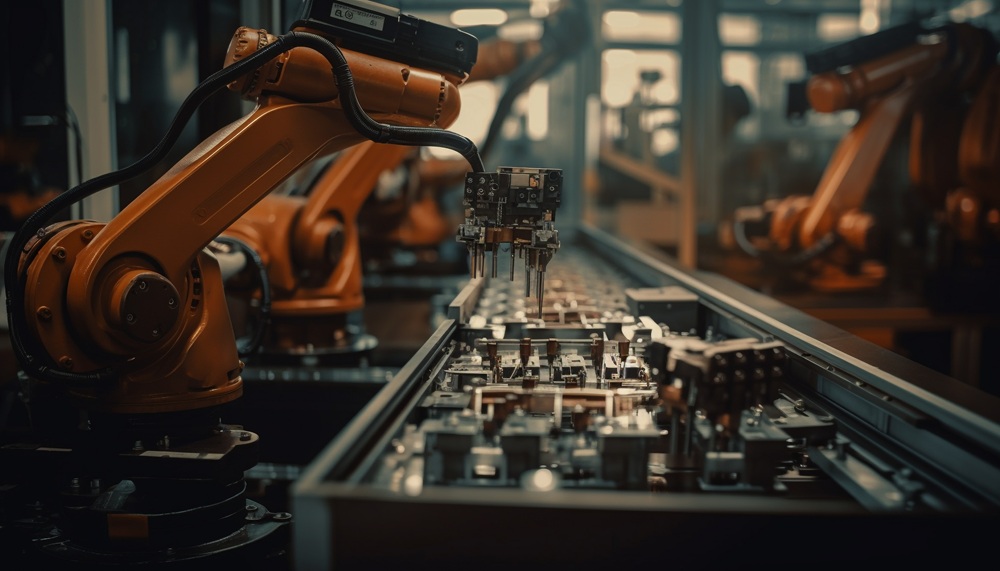

India’s manufacturing narrative is at an inflection point. As the country pushes toward becoming a $1 trillion manufacturing economy, a new concept has begun to capture boardroom imagination—the “dark factory.” A factory so automated that it does not require human presence on the shop floor, and therefore, theoretically, does not even need lighting.
At first glance, this aligns perfectly with India’s broader ambitions around Industry 4.0, AI-driven manufacturing, and global competitiveness. But beneath the surface lies a more complex story—one that oscillates between technological aspiration and systemic constraints.
What is a Dark Factory, and Why It Matters for India
A dark factory, also known as a “lights-out factory,” represents the extreme end of industrial automation. Machines, robotics, and AI systems handle production end-to-end, operating continuously with minimal human intervention. The benefits are compelling—24/7 productivity, reduced human error, higher precision, and optimized cost structures.
For India, the appeal is particularly strong. The country faces a paradox: it has a large workforce but also increasing challenges in skilled labour availability, quality consistency, and global competitiveness. Dark factories promise to resolve these contradictions by shifting the focus from labour-intensive manufacturing to precision-led, automation-driven output.
However, the idea often gets simplified into a binary—automation versus employment—when in reality, it is a far more nuanced structural shift.
The Polymatech Case: India’s First Dark Factory in Action
To understand both the promise and limitations of dark factories in India, one must begin with the country’s first real example—Polymatech Electronics in Kanchipuram, Tamil Nadu.
Located in the SIPCOT Hi-Tech SEZ in Oragadam, this semiconductor manufacturing unit represents India’s first operational dark factory. Inside its cleanroom environment, robotic arms assemble semiconductor chips with almost no human presence on the shop floor. Engineers monitor operations remotely, stepping in only for maintenance or oversight.
What makes this facility particularly significant is not just its automation level, but its continuity of operations. Machines function nearly uninterrupted, producing chips with nanometre-level precision and minimal error margins.
This is not a pilot project or a conceptual experiment—it is a working industrial system, producing real outputs in a sector (semiconductors) that demands extreme precision and consistency.
In many ways, Polymatech is India’s proof of possibility.
The Expectation: A Leapfrogging Opportunity
The emergence of dark factories has triggered a wave of optimism across India’s industrial and policy ecosystem. There is a growing belief that India can leapfrog traditional manufacturing stages, bypassing labour-heavy industrialization and moving directly into high-automation, high-value production.
This expectation is built on three core assumptions:
- Automation can compensate for inconsistent skill levels in the workforce
- AI-driven manufacturing can reduce dependency on human supervision
- Continuous production cycles can significantly improve output efficiency
In sectors like electronics, automotive components, pharmaceuticals, and defence manufacturing, this model appears particularly attractive. It aligns with initiatives like “Make in India” and semiconductor self-reliance, where precision and scale are critical.
Moreover, dark factories are seen as a way to make Indian manufacturing globally competitive—not just on cost, but on quality, reliability, and speed.
The Reality: India’s Structural Constraints
However, the transition from expectation to reality is far from straightforward. The Polymatech example, while impressive, is not easily replicable across the broader manufacturing ecosystem.
The challenges are deeply structural rather than technological.
1. Capital Intensity and ROI Pressures
Dark factories require massive upfront investment in robotics, AI systems, sensors, and precision engineering infrastructure. For large corporations, this may be feasible. For India’s vast base of MSMEs, which form the backbone of manufacturing, such investments are often prohibitive.
The question is not whether automation is desirable, but whether it is financially viable at scale across sectors.
2. Skill Paradox: From Labour Surplus to Skill Deficit
India’s labour advantage does not automatically translate into automation readiness. Dark factories do not eliminate human roles—they transform them.
Instead of operators, the system requires:
- Robotics engineers
- AI system designers
- Maintenance specialists
- Data analysts for predictive operations
The issue is that India currently faces a skill mismatch. While engineering graduates are abundant, there is a shortage of industry-ready, deep-tech talent capable of managing highly automated environments.
3. Infrastructure and Reliability Gaps
A dark factory is only as reliable as the ecosystem supporting it. Unlike traditional factories, where human intervention can compensate for system failures, dark factories rely entirely on predictive intelligence and system resilience.
India’s infrastructure challenges—intermittent power supply, logistics inefficiencies, and variable industrial ecosystems—pose a significant risk. Even a minor disruption in such a highly automated system can lead to disproportionate losses.
4. Energy Economics and Sustainability Trade-offs
Automation does not eliminate resource dependency—it shifts it. Dark factories are energy-intensive, especially in sectors like semiconductors.
In India, where energy costs are volatile and renewable integration is still evolving, this creates a critical tension. Scaling dark factories could increase dependence on high-cost or carbon-intensive energy sources, raising both operational costs and sustainability concerns.
The Human Question: Displacement or Transformation?
Perhaps the most debated aspect of dark factories in India is their impact on employment. The fear of job displacement is real, particularly in a country where manufacturing has traditionally been a major employment generator.
However, the Polymatech model offers a more nuanced insight. Humans are not eliminated—they are repositioned. Engineers supervise systems, focus on innovation, and intervene in high-value decision-making scenarios.
This suggests that the real challenge is not job loss, but job transformation. The workforce must transition from execution roles to cognitive, technical, and analytical functions.
The risk lies in the transition gap. If reskilling does not keep pace with automation, the disruption could be socially and economically significant.
Can India Truly Scale Dark Factories?
The answer lies somewhere between optimism and realism.
India is unlikely to see a rapid proliferation of fully dark factories across all sectors. Instead, what is more probable is a hybrid model:
- Select sectors (semiconductors, electronics, high-precision manufacturing) adopting near-dark environments
- Traditional sectors are gradually integrating automation in phases
- Human-machine collaboration is becoming the dominant operational model
Polymatech, in this context, is less a blueprint and more a signal—a glimpse into what is possible under ideal conditions of capital, technology, and ecosystem alignment.
Conclusion: From Hype to Strategic Evolution
Dark factories in India are not a myth—but neither are they an immediate reality at scale. They represent the direction of travel, not the current state of the ecosystem.
The real question is not whether India can build dark factories—it already has. The more important question is whether it can build the ecosystem required to sustain and scale them.
That includes:
- Deep-tech skill development
- Reliable energy and infrastructure
- Access to capital for industrial transformation
- Strong integration between AI, manufacturing, and policy
In the end, India’s manufacturing future may not be entirely “dark.” It will likely be a balanced interplay of automation and human intelligence, where machines handle precision and scale, and humans drive strategy, innovation, and resilience.
And perhaps that is the more realistic—and more powerful—vision of Industry 4.0 in India.