


- The survey encourages people to use technology mindfully and build deeper connections with loved ones.
- 72% parents and 30% children cite parents checking phones at dinner as the top deterrent to conversation.
- Parents and Children feel that dinner time becomes their strongest bonding moment when phones are kept aside.
- 67% of children say they turn to AI because parents are busy, this has lead to them speaking less with their parents.
- Meanwhile, phone-free moments significantly improve family engagement, with 91% of children saying conversations feel easier and more meaningful when smartphones are kept aside.

vivo India today released the seventh edition of its annual Switch Off Report understanding ‘The Impact of Excessive Smartphone Usage on Parent-Child Relationships’. This year’s edition reinforces the central purpose behind vivo’s Switch Off initiative — encouraging people to foster better relationships with their smartphones and priotitize real life relationships. The report is the part of the larger Switch Off initiative which emphasizes spending more time with your loved ones.
As digital connectivity becomes deeply woven into everyday life, the study explores how families are adapting to changing digital behaviour and uncovers two defining insights: families feeling dinner time as their most reliable moment of daily connection and children turning to AI as they feel their parents are too busy.
The study highlights that 72% of children spend most time with their parents during phone-free moments. With 91% of children saying conversations feel easier and more meaningful when phones are kept aside, dinner becomes a natural space where attention aligns and families reconnect. Encouragingly, the study highlights a growing willingness among families to rebuild these shared moments. Parents and children are experimenting with simple behavioural shifts reducing notifications, keeping phones away from shared spaces, or choosing offline activities which help them feel more in control and more present. Families report that the more they practice small phone-free habits, the easier it becomes to protect these moments of real connection.
The report further highlights another significant shift this year, a growing number of children turning to AI tools for learning and guidance. Driven by curiosity, creativity, and evolving academic needs, 54% of children aged 10–16 have emerged as early adopters, using AI freely in their daily lives. Their usage spans homework and assignments (61%), personal growth and development (63%), and, notably, 33% even view AI as a companion, occasionally substituting real-life relationships.
A key reason that children prefer these AI chatbots and prefer them over their parents is the perception that their parents are too busy. As a result, they feel they are spending less time with their parents, with 1 in 4 children explicitly claiming they speak to their parents less because of AI.
Underlining the focus behind the Switch Off campaign, Geetaj Channana, Head of Corporate Strategy, vivo India, said, “At vivo, we believe technology should strengthen real relationships, not distance people from them. While smartphones bring learning, convenience and connection, using them mindfully is essential for nurturing healthier family interactions. The findings of this year’s Switch Off Study remind us that families are actively seeking balance, choosing to disconnect during key moments and rebuild presence in their everyday lives.”
Deep diving on daily usage pattern, the study also reveals that children and parents relate to smartphones very differently. Children primarily use their devices for entertainment, self-expression and personal downtime, and they tend to put their phones aside when they feel seen and heard. Parents, however, often slip into habitual micro-checking triggered by work notifications or routine behaviour—which sends signals of emotional unavailability. Children are quick to notice these interruptions, describing them as moments where conversations “drop mid-sentence” or lose warmth, deepening the emotional distance between the two groups. This imbalance is reinforced by the finding that parents are significantly more active on their phones across shared moments—such as during movie time (70% vs. 31%), family celebrations (64% vs. 59%) while children tend to disconnect more easily in these same settings.
Digital Behaviour & Family Routines
- Parents spend 4.4 hours and children 3.5 hours daily on smartphones, creating interruptions that affect shared time and presence.
- Parents and children use smartphones differently across the day — parents through multiple short check-ins, and children through longer entertainment-focused sessions.
- Parents are significantly more active on their phones across shared moments such as during movie time (70% vs. 31%), family celebrations (64% vs. 59%), and even at the dining table (53% vs. 32%) — while children tend to disconnect more easily in these same settings.
- Smartphone usage varies across demographics: mothers 4.2 hours, fathers 4.4 hours, boys 4.0 hours, girls 3.0 hours, reflecting differing needs and habits.
- Daily routines naturally integrate smartphone use — morning notifications, afternoon OTT viewing and late-night scrolling.
AI & Digital Confidence
- AI adoption differs significantly by age and gender: 83% of boys aged 13–14 rely on AI tools, compared to 38% of girls aged 10–12, who use AI more selectively.
- Frequent reliance on AI can reduce moments of curiosity-driven conversation with parents, underscoring the importance of guided digital interactions.
Emotional Dynamics of Attention & Presence
- Children say conversations are far richer when parents are attentive; 91% report that they talk more easily when phones are kept aside.
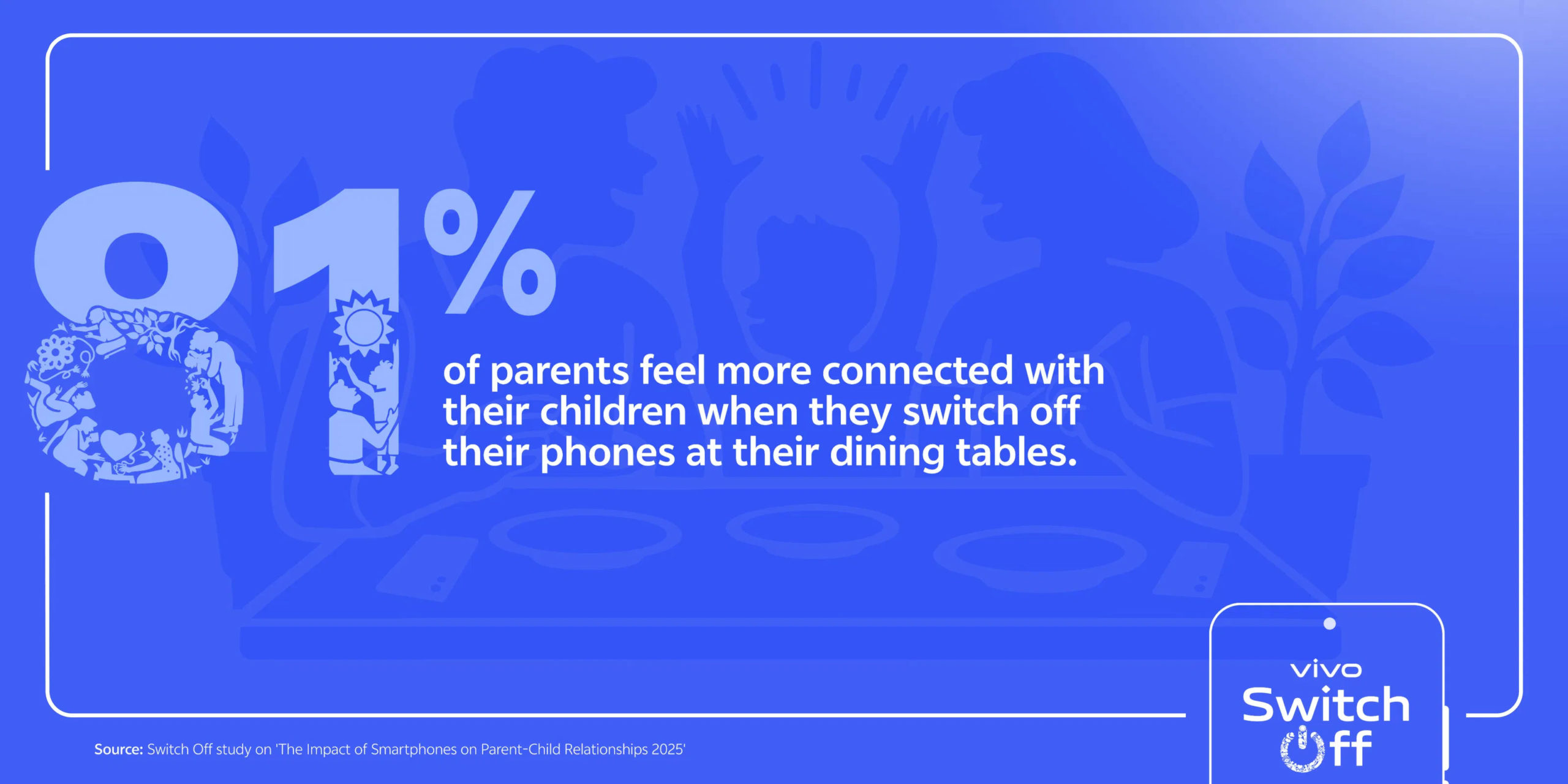
- No-phone dinners significantly improve shared interactions, with 87% of children feeling more comfortable talking and 81% of parents noticing stronger bonding with their child.
- Teens describe parental micro-checking as disruptive, noting that even brief glances at a phone can interrupt the emotional flow of conversations.
- Meaningful connection is associated with uninterrupted attention, steady eye contact and conversations that don’t drop mid-sentence.
Efforts to Reconnect with Each Other Through Meaningful Measures
- Limiting screen time: 54% parents, 49% children
- Blocking social media during certain hours: 51% parents, 41% children
- Turning off non-essential notifications: 49% parents, 50% children
- Switching to basic phones/digital detox periods: 47% parents, 30% children
Impact of These Solutions
- Felt more in control: 59% parents, 47% children
- Inspired to continue healthier digital habits: 51% parents, 57% children
- Wished they had started earlier: 40% parents, 43% children
- Gained confidence in managing smartphone use: 40% parents, 33% children
- A minority reported frustration or disconnection: 31% parents, 20% children
- Children adjust their usage more when those around them stay offline, showing the power of modelling over rules.
Family Aspirations & Shared Intent
- Parents and children express a shared desire for fewer interruptions and deeper presence during everyday conversations.
- Families want predictable phone-free zones at home — especially around routines that naturally bring everyone together — to preserve warmth, openness and togetherness.
- Both groups aspire to build healthier, more collaborative digital boundaries that support stronger emotional connection.
The Switch Off campaign is rooted in a simple yet powerful idea — encouraging people to disconnect from screens for a moment and reconnect with what truly matters. Through this initiative, vivo aims to inspire individuals to build healthier relationships with their loved ones.
About the Study:
The vivo Switch Off Study 2025 contains insights from a Quantitative study followed by a Qualitative Study to understand the insights in depth. The Quantitative study covered 1517 smartphone owners comprising 1017 parents and 500 children across the top 8 cities of India: New Delhi, Mumbai, Kolkata, Chennai, Hyderabad, Bangalore, Ahmedabad and Pune. The Qualitative Study covered 18 smartphone owners comprising 12 parents and 6 children across New Delhi and Mumbai. The parents surveyed were in the 35-50-year age bracket who had children who were 10-16 years old. The children surveyed were 10-16 years old.
The study was executed by CyberMedia Research (CMR), India’s trusted market research and advisory firm.