

- Software-first EV platforms drove 34% YoY growth in connected electric two-wheelers
- Digital clusters expanded to 58% of two-wheelers, led by EV adoption
- TVS retained E2W leadership, with Bajaj and Ather close behind
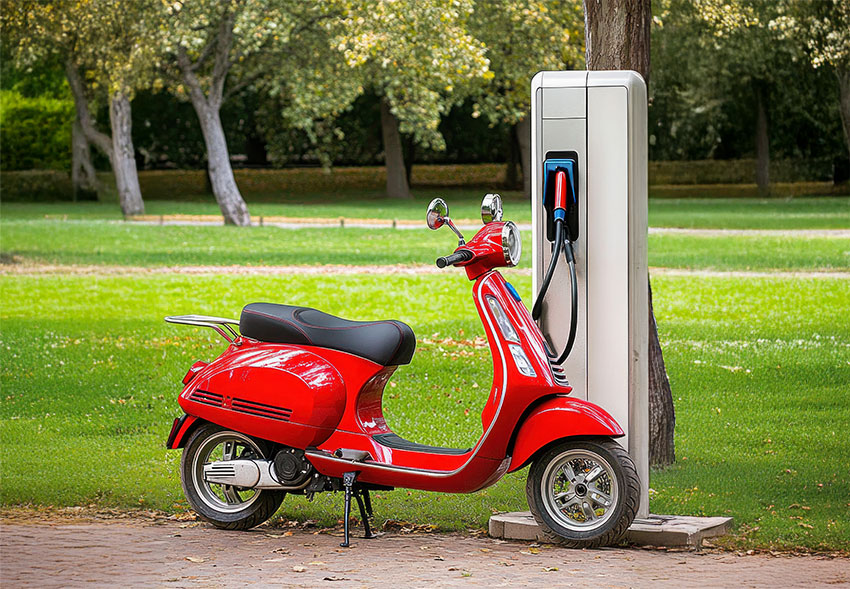
Delhi/Gurugram, 27 Feb 2026: India’s Electric Two-Wheeler (E2W) market maintained its upward trajectory, growing 17% year-on-year (YoY) in Q4 2025, according to CyberMedia Research (CMR) in its latest CMR India Electric Two-Wheeler Market Review Report for Q4 2025. The growth in the E2W segment was supported by government incentives, improving affordability, and rising consumer preference for digitally enabled mobility solutions. Urban demand remained a key growth driver, aided by favourable financing options and festive-season purchase cycles.
According to Shipra Sinha, Senior Analyst – Smart Mobility Practice, CMR, “India’s Electric Two-Wheeler market growth is being driven by a combination of policy support and rising consumer expectations around technology-led riding experiences. EVs, by design, are software-first, enabling faster adoption of connected features, digital clusters, and app-enabled functionalities. As a result, E2Ws are no longer viewed purely as cost-efficient alternatives, but as smart mobility devices.”
EV incentives under PM E-DRIVE and PLI schemes, along with state-level subsidies timed around Diwali–Dhanteras, improved affordability and boosted retail momentum. Improved credit availability and flexible financing options further supported adoption across urban and select semi-urban markets.
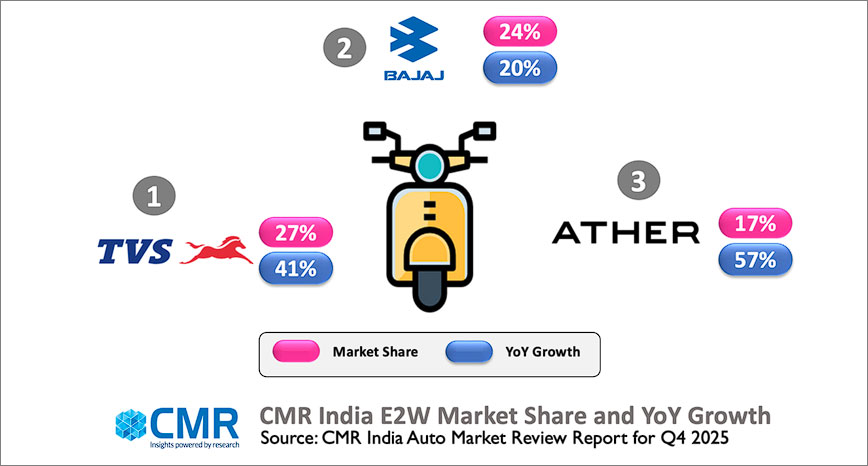
Technology Trends and Market Leadership Q4 2025
- Connected Growth: The connected E2W segment grew 34% YoY, with 88% of electric models offering connected technology. This growth is driven by the software-led architecture of EVs, where embedded telematics come as standard, enabling app connectivity, OTA updates, navigation, ride analytics, and remote diagnostics.
- Digital Cluster Adoption: Digital cluster adoption in the 2W segment increased to 58%, up from 35% in Q4 2024, driven by rising demand for connected features, enhanced rider information, and OEM focus on tech-led product differentiation across EV models.
- Touchscreen Displays: Notably, 28% of E2Ws were equipped with touchscreen displays, with 62% of them offering 7-inch panels. As EVs increasingly adopt digital architectures, larger touch displays enable seamless smartphone integration and richer user interfaces.
- Market Leadership:
- TVS Motor Company led India’s E2W segment in Q4 2025 with a 27% market share, underscoring sustained consumer confidence in its iQube portfolio.
- Bajaj Auto followed with a 24% share, supported by strong urban demand for the Chetak.
- Ather Energy captured 17% share, registering an impressive 57% YoY growth driven by the success of its Rizta and 450 series.
- Ampere (Greaves Electric Mobility) posted a robust 61% YoY increase, with its Magnus and Nexus models together accounting for nearly 80% of the brand’s volumes.
- Ola Electric witnessed a 61% YoY decline, impacted by a combination of operational challenges, service quality concerns, and backlog-related issues, which affected consumer confidence during the quarter.
Future Market Outlook
In CY2026 and beyond, CMR expects continued growth in India’s Electric Two-Wheeler market, supported by rising adoption of connected technologies. E2Ws are projected to account for 10–12% of the overall two-wheeler market by end-CY2026.
“As we look ahead to 2026 and beyond, Electric Two-Wheelers are poised for sustained growth, driven by urban replacement demand, increasing household adoption of EVs, and the mainstreaming of connected and smart mobility features. OEMs will increasingly leverage data-driven experiences and digital differentiation to enhance consumer value and engagement. At the same time, deeper penetration into semi-urban and rural markets is expected to unlock the next phase of volume-led growth,” added Amit Sharma, Senior Analyst – Smart Mobility Practice, CMR.