

For over a decade, the smartphone industry has competed on familiar battlegrounds—camera megapixels, processor performance, battery capacity, and display quality. Every product launch introduced incremental hardware upgrades, encouraging consumers to compare specifications before making a purchase. While these factors continue to influence buying decisions, they are no longer the only measures of a smartphone’s value. Increasingly, consumers are looking beyond hardware to understand how a device can simplify everyday life. Artificial Intelligence (AI) is driving this shift, with Consumer AI transforming smartphones into intelligent companions that enhance daily experiences in meaningful ways.
AI Is Changing What Consumers Value
At CyberMedia Research (CMR), our market insights point to this evolution particularly in Aspirational India, across Tier II, Tier III cities and beyond.
As consumers become more digitally confident, expectations are also changing. Rather than focusing solely on specifications, they are evaluating how seamlessly a smartphone fits into their lifestyle. AI has moved beyond being a premium feature reserved for flagship devices. Today, it is becoming a practical utility that saves time, improves creativity, and delivers better outcomes with minimal effort.
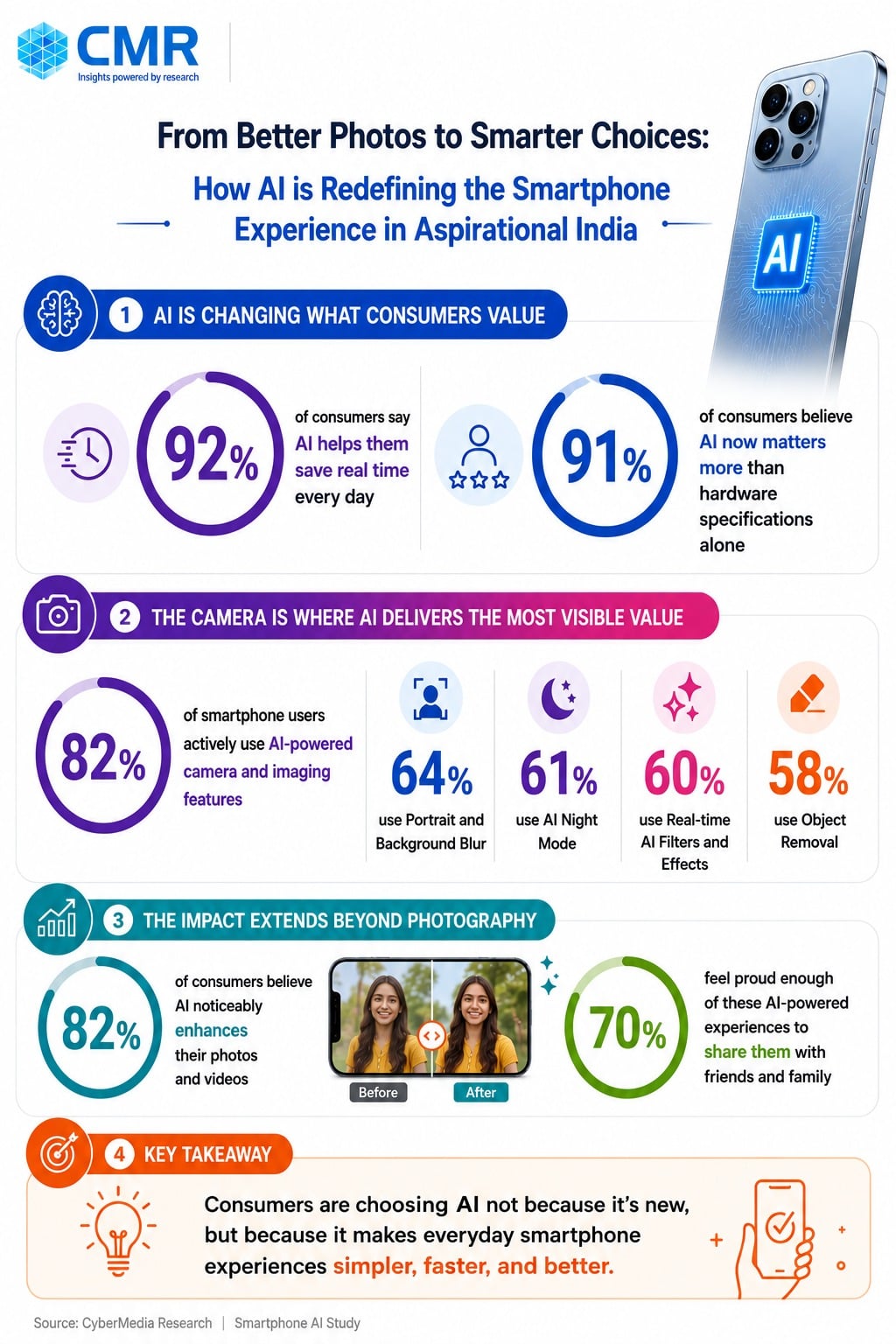
CyberMedia Research’s latest Smartphone AI Study highlights this changing consumer mindset. The findings reveal that 91% of consumers believe AI now matters more than hardware specifications alone, while 92% say AI helps them save real time every day. These insights suggest that AI is no longer perceived as an optional enhancement. Instead, it is becoming central to how consumers define a truly smart smartphone.
The Camera Is Where AI Delivers the Most Visible Value
One of the clearest examples of this transformation can be seen in smartphone photography. For most users, the camera remains one of the most frequently used features, making it the first place where AI demonstrates tangible value. Rather than requiring users to understand complex settings or editing tools, AI works quietly in the background, automatically improving images and videos. It is this simplicity that has made AI relevant to everyday consumers.
CMR’s research shows that 82% of smartphone users actively use AI-powered camera and imaging features, underlining how AI has become an integral part of daily photography. Among the most widely used capabilities, 64% use Portrait and Background Blur, allowing them to create professional-looking portraits with minimal effort. AI Night Mode is used by 61% of consumers, helping capture clearer images in challenging lighting conditions, while 60% rely on Real-time AI Filters and Effects to personalise photos and videos instantly. Object Removal is used by 58% of users, reflecting the growing demand for effortless editing, while 56% benefit from Auto-Enhancement to improve image quality automatically. 51% use AI Video Stabilisation, ensuring smoother videos without requiring specialised equipment.
Consumers are not adopting AI because it sounds futuristic. They are embracing AI because it solves everyday problems. Better portraits, clearer night photographs, smoother videos, and quicker editing are practical benefits that users experience immediately. AI succeeds when it quietly removes complexity, allowing consumers to focus on capturing moments rather than managing technology.
Why Aspirational India Is Raising Expectations
This shift also explains why Aspirational India is redefining what makes a smartphone truly smart. Consumers in emerging markets are increasingly value conscious, but they are equally experience driven. They expect smartphones to understand their needs, simplify routine tasks, and deliver consistently better results. Whether it is preserving memories during family celebrations, creating social media content, or enhancing everyday communication, AI is becoming an essential part of the user experience rather than an additional feature.
The impact extend beyond photography. CMR’s research found that 82% of consumers believe AI noticeably enhances their photos and videos, while 70% feel proud enough of these AI-powered experiences to share them with friends and family. This growing confidence reflects a deeper behavioural shift. Technology becomes truly mainstream when users trust it, rely on it regularly, and recommend it through their own experiences. AI is now reaching that stage of adoption.
What This Means for Smartphone Brands
For smartphone brands, this evolution presents both an opportunity and a challenge. The next phase of competition will not be determined by who offers the highest number of AI features, but by who delivers the most meaningful AI experiences. Consumers are increasingly interested in outcomes rather than algorithms. They value smartphones that save time, reduce effort, and improve everyday moments without requiring technical expertise.
Hardware innovation will remain important, yet it is AI that increasingly defines how consumers experience and value their devices. From enhancing photography to simplifying daily interactions, AI is quietly reshaping expectations and influencing purchase decisions. As these expectations continue to grow, the definition of a truly smart smartphone will no longer be based on specifications alone, but on how naturally technology fits into everyday life and empowers consumers to do more with confidence.
Smartphone brands that communicate the real-world benefits of smartphone AI clearly will build stronger connections with consumers, particularly across Aspirational India, where expectations continue to evolve alongside digital adoption.