






Jul 30, 2026
Beyond Digitalization: Why Cognitization Will Define the Next Era of Supply Chains
Read More

New Delhi/Gurugram, 13 July 2026. As AI becomes more deeply integrated into core smartphone experiences, consumers are increasingly prioritising AI experiences that feel secure, responsive, and privacy-conscious. Trust is increasingly emerging as a key factor influencing...

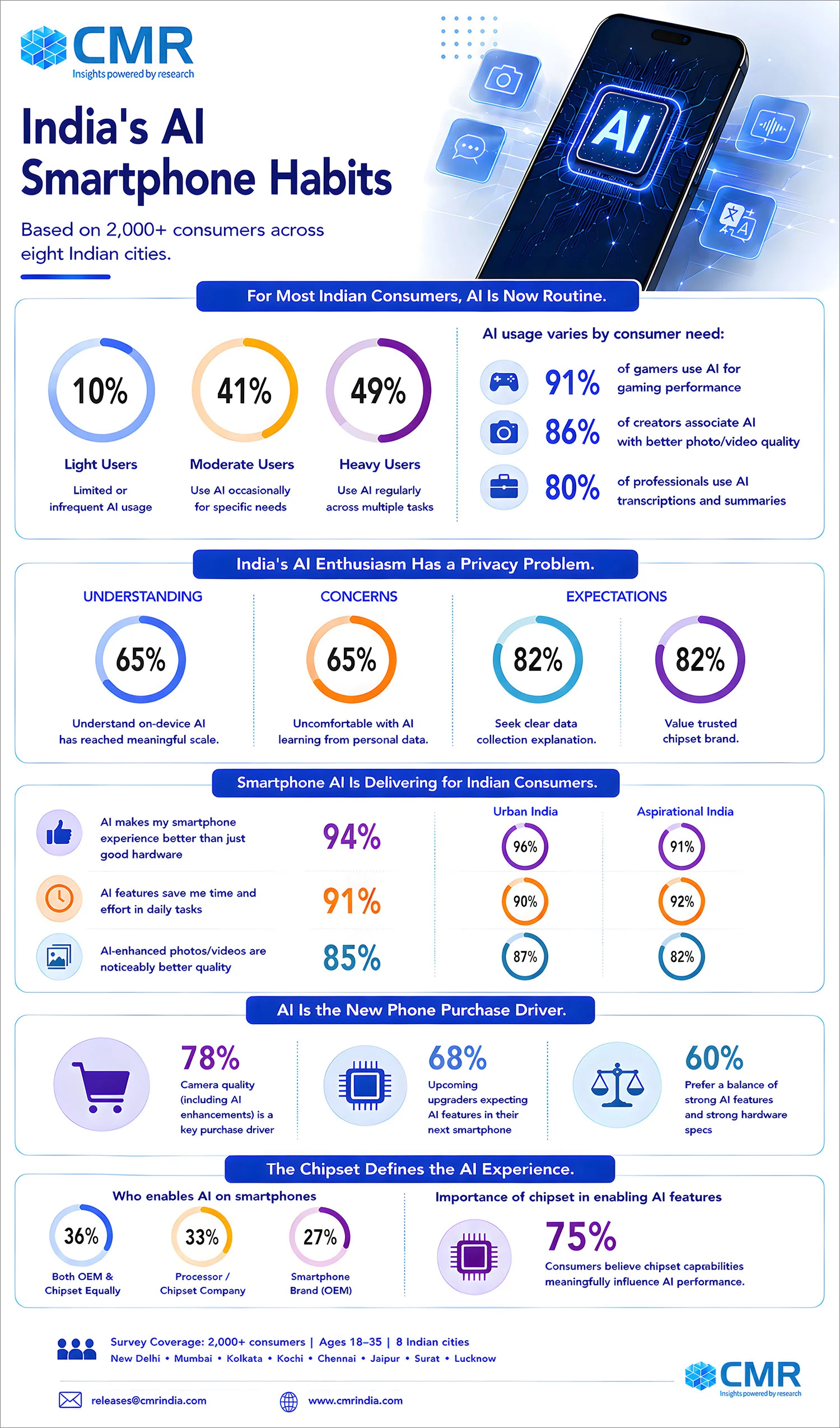
New Delhi/Gurugram, 13 July 2026. As AI becomes more deeply integrated into core smartphone experiences, consumers are increasingly prioritising AI experiences that feel secure, responsive, and privacy-conscious. Trust is increasingly emerging as a key factor influencing AI adoption and purchase consideration. An overwhelming 82% of consumers say transparent data practices would improve trust in smartphone AI experiences, while 61% believe on-device AI processing improves both responsiveness and privacy.
Cyber Media Research (CMR), one of India’s leading technology research and advisory firms, has today released the CMR Smartphone AI Pulse 2026 — the first major study in India to examine how consumers discover, adopt, and experience AI on their smartphones. The study covered over 2,000 smartphone users aged 18–35 across eight Indian cities in Urban and Aspirational India.
According to Prabhu Ram, VP – Industry Research Group (IRG), Cyber Media Research (CMR), “Our research points to a fundamental shift in how Indian consumers evaluate their smartphones. AI is no longer viewed as an added feature; it is increasingly shaping the overall device experience. Across demographics and price segments, consumers expect AI that is useful, intuitive, and seamlessly integrated into everyday interactions. As these expectations evolve, AI capabilities will play a growing role in smartphone differentiation and purchase decisions going forward.”
AI Engagement Is Deep, But Unevenly Distributed
57% of consumers clearly understand and actively use AI features, while 43% engage only partially. Among active users, 49% are heavy users engaging with five or more AI features regularly, 41% are moderate users, and 10% engage with AI only when prompted. The moderate user segment — the largest share — represents significant untapped potential for the industry.
The generational contrast is telling. 72% of Gen Z consumers view AI as an important factor in their next smartphone purchase, compared to 65% of millennials. Gender shapes engagement too — 66% of female consumers lead with camera and imaging use cases, while 42% of male consumers prioritise productivity and communication.
AI Is Now Central to Smartphone Purchase Decisions
Consumer definitions of what makes a good smartphone have shifted meaningfully. Performance (78%), camera quality including AI enhancements (70%), and strong AI features (59%) now constitute the top three defining attributes — with AI ranking ahead of design, price, and battery life. AI is increasingly being treated as a core purchase consideration.
When asked to choose between two smartphones at a similar price, 60% of consumers want a balance of AI and strong hardware, unwilling to sacrifice either. 25% are outright AI-first buyers, while only 15% remain hardware traditionalists.
AI Adoption Is Broad and Deeply Embedded
77% of consumers actively use AI imaging features — including low-light enhancement, portrait optimisation, and intelligent scene detection — making photography the strongest gateway into everyday AI adoption. 71% use Generative AI features multiple times per week across AI-assisted search, summarisation, writing support, translation, and conversational interfaces, reflecting a consumer base that has moved well beyond passive awareness into habitual engagement.
Consumer Awareness Around AI Hardware Is Growing
AI is increasingly becoming a decisive factor in smartphone purchase decisions. 68% of consumers identify chipsets as important enablers of AI performance — across gaming smoothness, imaging quality, responsiveness, and battery optimisation — with Gen Z leading this awareness at 83%, well above the study average.
As chipset awareness grows, consumers are increasingly evaluating AI capabilities across smartphone platforms powered by leading chipset providers in India. In this increasingly competitive landscape, MediaTek continues to lead the Indian smartphone chipset market with a 47% share of smartphone chipset shipments, according to the CMR India Mobile Handset Market Review Report, while also enjoying strong consumer sentiment among its user base
The survey found that 93% of MediaTek users reported a positive device experience. Additionally, >45% expressed a preference for MediaTek-powered devices.
“As AI utility deepens and consumer literacy around chipsets and on-device processing grows, the competitive battleground is moving from hardware specifications to experiential trust. Consumers increasingly evaluate AI experiences through the lens of trust, privacy, and real-world utility. This shift is likely to influence how AI is designed, communicated, and differentiated across future smartphone generations,” added Sourabh Pandey, Analyst, Cyber Media Research (CMR).


Gurugram/New Delhi, July 01, 2026: India’s HDD storage market is witnessing renewed momentum, driven by growing demand for...
More Details
Gurugram/New Delhi, June 26, 2026: Evolving supply strategies and memory pricing pressures impacted flash device shipments in Q1...
More Details
Gurugram/Delhi, 24 June 2026. India’s MSMEs are rewriting their growth playbook. A new study by Cyber Media Research (CMR)...
More Details