

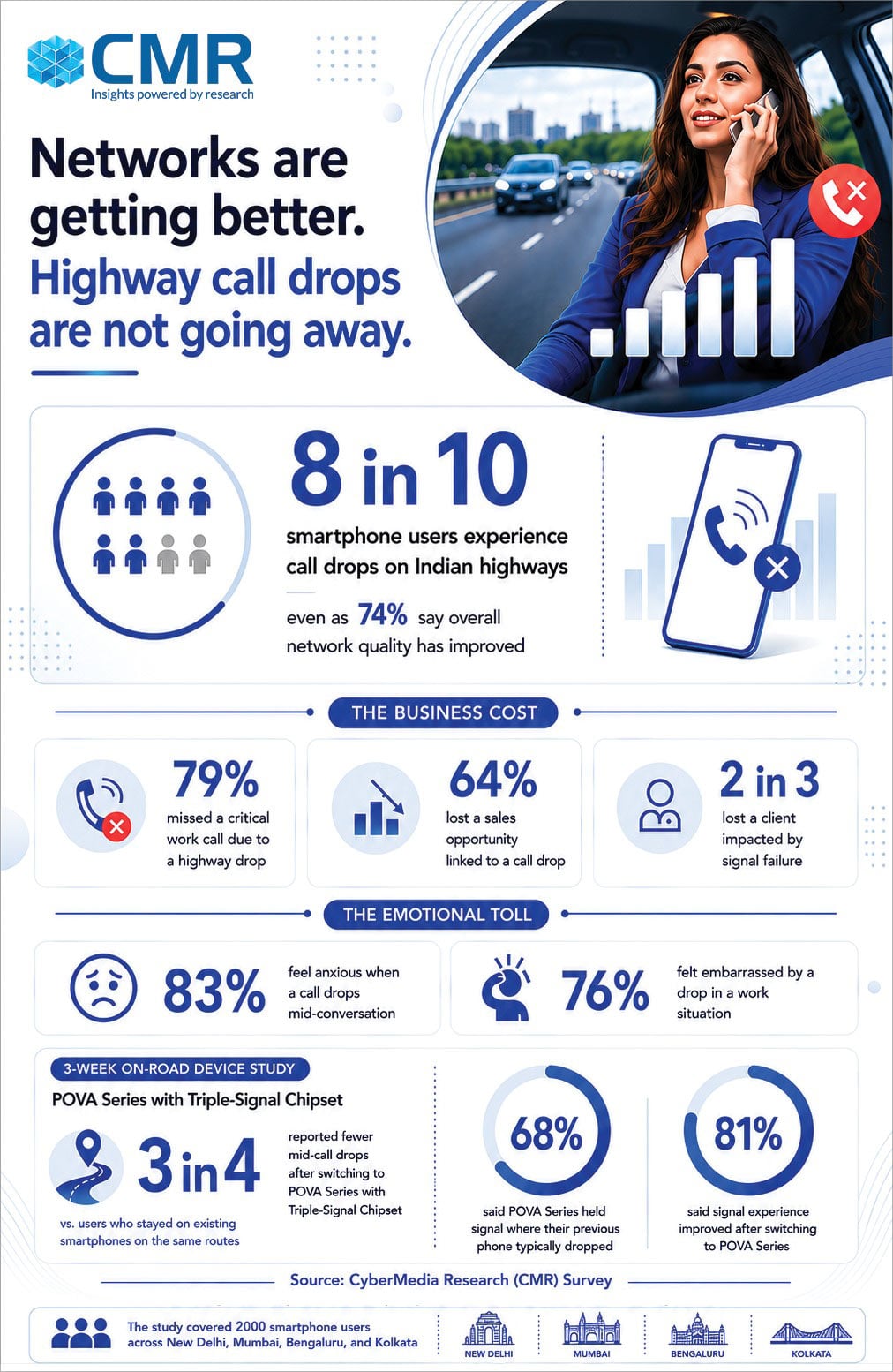
8 in 10 smartphone users face connectivity interruptions on Indian highways. 2 in 3 business users say they have lost a client to poor signal. A new CyberMedia Research study points to smartphone hardware as an under-appreciated factor in real-world connectivity.

- 2 in 3 business users lost a client they attribute to poor signal performance
- 83% feel anxious or helpless when an important call is interrupted
- 81% report a better signal experience after switching to a triple-chipset device
New Delhi 03 June 2026 — Nearly 8 in 10 smartphone users (79%) experience call drops or connectivity interruptions while travelling on Indian highways, according to a new study by CyberMedia Research (CMR), one of India’s leading technology research and advisory firms. While mobile network coverage has expanded significantly across the country, the study finds that maintaining uninterrupted connectivity on the move remains a real-world challenge — and that the consequences for working professionals are both financial and emotional.
Among respondents who use their phone for business, more than half reported a direct monetary impact in the past 30 days — from missed orders to delayed payments. The study found that 64% lost a sales opportunity or client deal they attribute directly to a call drop, and 2 in 3 said they had lost a client they believed was affected by their phone’s signal performance.
The emotional cost was just as pronounced. 83% said call drops during important conversations leave them feeling anxious or helpless, and 71% had to call a customer back after a dropped call — an interruption many felt damaged their professional image.
According to Prabhu Ram, VP – Industry Research Group (IRG), CyberMedia Research (CMR): “India has made real progress in expanding mobile coverage, yet consistent connectivity remains a challenge in everyday environments — highways, metros, and indoor low-signal zones. The impact goes well beyond a single dropped call; our respondents link these interruptions to missed business, broken conversations, and lower confidence in moments that matter. As the smartphone becomes central to work and daily life, people increasingly expect connectivity that is not just available, but dependable — and device design is emerging as one factor in that experience.”
Device design emerges as a factor
The study also examined how smartphone design — not just network infrastructure — may shape connectivity in challenging mobility environments. In an exploratory assessment, frequent highway travellers using a smartphone with triple-signal chipset technology (POVA Series) shared feedback on their experience during regular inter-city travel:
- 81% — reported an improved signal experience after switching devices
- 74% — reported a more reliable calling experience during highway travel
- 72% — reported faster signal recovery after passing through weak-coverage areas
The findings suggest that while network infrastructure remains the primary driver of connectivity, device-level signal optimisation may be an under-appreciated contributor to a more consistent experience on the move.
Note to Editors
The study is based on a survey of 2,000 smartphone users aged 18–35 across New Delhi, Mumbai, Bengaluru, and Kolkata, assessing the prevalence and impact of connectivity interruptions during highway travel.
In addition, CMR conducted an exploratory user feedback assessment among frequent highway travellers to understand perceived connectivity experiences with devices featuring advanced signal optimization technologies.
The study was conducted with a 95% confidence level and a ±3% margin of error.
Important Notes
- Findings are based on self-reported consumer experiences and perceptions.
- Trial findings reflect user-reported experiences under real-world usage conditions and do not constitute controlled technical measurements of network or device performance.
The study was commissioned by POVA. Research design, fieldwork, analysis, and reporting were independently conducted by CyberMedia Research (CMR).