


From Firefighting to Autonomous Flow with Agentic AI and Digital Workers
This article is based on the keynote address delivered by V. Srinivasa Rao (VSR), Chief Digital Advisor, CyberMedia Research (CMR), and Chairman & Managing Director, BT&BT, during CMR’s webinar, “Digital Supply Chain Transformation: From Reactive Firefighting to Continuous Autonomous Flow.”
For over two decades, enterprises have invested relentlessly in modernizing their supply chains. ERP systems integrated fragmented processes. IoT devices connected factories, warehouses and fleets. Analytics delivered unprecedented visibility into inventory, demand and logistics. Artificial Intelligence promised predictive insights that could anticipate disruptions before they occurred.
Yet despite these advances, one uncomfortable reality continues to define supply chain operations across industries. Most supply chains remain trapped in a perpetual cycle of firefighting: A delayed shipment. An unexpected surge in demand. A supplier unable to deliver. A weather disruption affecting transportation. A production line waiting for a single critical component.
When these events occur, organizations still depend on human experts to assess the situation, coordinate across functions, make decisions and manually execute corrective actions. Technology may highlight the problem, but people remain responsible for solving it.
This is precisely why many organizations that consider themselves digitally mature still struggle to achieve supply chain resilience.
The next frontier, therefore, is no longer digitalization. It is Cognitization.
Digitalization Has Reached Its Limits
Over the last fifty years, enterprise operations have evolved through distinct stages. The first era was dominated by manual processes, where planning, procurement, inventory management and logistics depended almost entirely on human effort.
The second phase introduced enterprise automation through ERP systems and integrated business applications. Routine workflows became standardized, transactional efficiency improved and organizations gained greater process discipline.
The third phase—digitalization—added an entirely new layer of capabilities. Mobile access, cloud computing, IoT, advanced analytics and AI-enabled forecasting transformed enterprise visibility. Supply chains became increasingly connected, allowing organizations to monitor operations in near real time and make more informed decisions.
These investments unquestionably created enormous business value. However, they largely addressed one challenge: better information.
They did not fundamentally change how decisions are made.
People still review dashboards.
People still interpret alerts.
People still decide which supplier should receive the next purchase order.
People still determine whether inventory should be redistributed.
People still decide whether shipments should be rerouted.
In other words, enterprises have successfully digitized information—but decision-making remains overwhelmingly human.
That is the gap Cognitization seeks to close.
Introducing Cognitization: The Fourth Stage of Enterprise Evolution
Cognitization represents a shift from systems that merely process information to systems capable of thinking through operational decisions.
Unlike conventional automation, which executes predefined rules, cognitized systems continuously perceive their environment, interpret changing conditions, reason about possible responses, determine optimal actions and execute them autonomously within clearly defined governance boundaries.
Imagine a supply chain capable of sensing an unexpected spike in demand.
Instead of generating an alert for planners to investigate, the system evaluates available inventory, assesses supplier capacity, identifies transportation options, creates procurement plans, issues purchase orders, adjusts production schedules and escalates only those exceptions requiring executive approval.
This is not simply automation. It is intelligent operational orchestration, and the distinction is profound: Digitalization answers questions. Cognitization takes action.
The Rise of Digital Workers
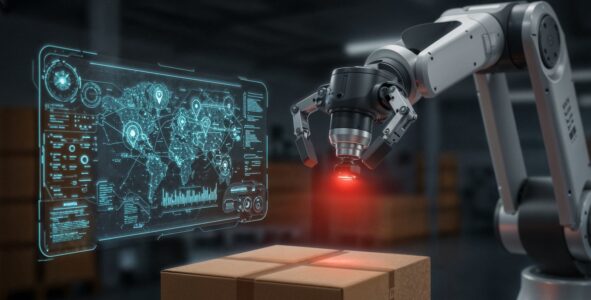
At the heart of Cognitization lies a new enterprise asset: the Digital Worker.
Much has been written about AI agents over the past year, yet many organizations still equate AI agents with conversational assistants or sophisticated chatbots.
That perspective dramatically underestimates their potential.
A true Digital Worker functions much like a skilled employee.
It continuously perceives information from ERP systems, IoT sensors, supplier networks, weather services, warehouse management systems and market signals.
It reasons about what those signals actually mean. It plans an appropriate response. It executes actions directly within enterprise applications. It then reflects on the outcome, compares actual performance against expected results, learns from experience, updates its understanding and becomes progressively more effective.
Perhaps most importantly, it understands its own limitations. Just as experienced managers know when to seek expert advice, intelligent Digital Workers recognize situations where confidence levels are low or policy thresholds are exceeded and automatically involve human decision-makers.
This ability to know when not to act independently is one of the defining characteristics of trustworthy enterprise AI. Digital Workers are therefore not designed to replace human judgment. They are designed to extend it.
A New Operating Model for the Enterprise
Perhaps the most significant implication of Cognitization is not technological—it is organizational.
For decades, enterprises have operated with two kinds of workers:
- Human employees performing cognitive work.
- Robotic systems executing physical tasks on factory floors and warehouses.
The future introduces a third category: Digital Workers. These intelligent software agents become active participants in enterprise workflows.
Demand planning agents continuously monitor market signals.
Inventory agents optimize stock positions.
Procurement agents evaluate supplier performance and initiate sourcing decisions.
Logistics agents identify optimal transportation routes based on weather, cost, capacity and service-level commitments.
Governance agents monitor policy compliance, risk exposure and regulatory requirements.
Rather than replacing existing teams, these agents assume repetitive analytical work, allowing human experts to concentrate on strategic planning, innovation, supplier relationships and exception management.
The enterprise workforce becomes a collaborative ecosystem comprising humans, Digital Workers and robotic workers—each contributing according to their strengths.
Decision Intelligence Becomes the New Competitive Advantage
Traditional Business Intelligence transformed enterprise reporting.vArtificial Intelligence transformed prediction, and Agentic AI aims to transform execution. For years, analytics answered two fundamental questions:
What happened?
Why did it happen?
Predictive AI added a third:
What is likely to happen?
Agentic AI introduces an entirely new capability:
What should be done next—and can the system execute it autonomously?
Consider transportation planning. A traditional system identifies severe weather disrupting a logistics corridor. A predictive system forecasts shipment delays. A cognitized supply chain automatically evaluates alternate routes, compares transportation costs, estimates delivery commitments, checks fleet availability, books alternative carriers where appropriate and updates downstream production schedules before disruption occurs.
The difference is no longer intelligence alone. It is intelligent action.
Organizations capable of converting insights directly into execution will increasingly outperform those still dependent upon manual coordination.
Why Many AI Initiatives Continue to Fail
Despite extraordinary investment, enterprise AI has not consistently delivered transformational business value. One reason is that organizations frequently treat AI as an overlay rather than an operating model. They deploy intelligent agents while preserving workflows originally designed for human execution.
That approach rarely succeeds. Introducing Digital Workers requires organizations to rethink governance, approval hierarchies, exception handling, operating procedures and accountability structures.
Equally critical is data quality. Even the most sophisticated Digital Worker cannot compensate for inaccurate master data, fragmented enterprise systems or disconnected workflows. Intelligence depends entirely upon the quality of information available.
Garbage in still produces garbage out—only faster. Successful organizations therefore begin not with AI deployment but with business outcomes:
Which KPIs require improvement?
Which decisions create bottlenecks?
Which repetitive cognitive activities consume disproportionate human effort?
Only after answering these questions should enterprises determine where Digital Workers create measurable value.
Human-in-the-Loop Is Not Optional
Discussions around autonomous enterprises often trigger concerns about workforce displacement. That is the wrong conversation. The objective of Cognitization is not workforce reduction. It is workforce elevation.
Routine decision-making migrates to intelligent agents. Human expertise shifts toward governance, creativity, strategic thinking, ethical oversight and complex exception handling.
Enterprises should deliberately define where autonomous execution is appropriate and where human approval remains mandatory: Large procurement commitments; High-risk sourcing decisions; Regulatory exceptions; Financial exposure beyond predefined thresholds; etc.
These remain areas where human judgment continues to provide irreplaceable value.
The future enterprise will therefore not be fully autonomous. It will be intelligently supervised.
Cognitization is a Business Strategy, Not an AI Strategy
Too often, organizations frame Agentic AI as another technology initiative. That mindset risks repeating mistakes made during previous waves of digital transformation. Cognitization is fundamentally a business transformation strategy. It requires organizations to rethink operating models, redesign workflows, redefine employee roles, establish governance frameworks and create measurable links between intelligent automation and business performance.
Technology becomes the enabler—not the destination. Enterprises that embrace this shift early will build supply chains capable of sensing disruption, reasoning through alternatives, executing decisions at machine speed and continuously learning from outcomes.
Those that merely digitize existing processes may achieve incremental efficiency. Those that cognitize them will achieve enduring competitive advantage.
The Road Ahead
Every major wave of enterprise transformation has changed the relationship between people and technology. Automation reduced manual effort. Digitalization connected information. Cognitization introduces intelligence into execution.
The emergence of Agentic AI and Digital Workers marks the beginning of this next chapter.
Supply chains of the future will no longer depend on endless firefighting or fragmented human coordination. Instead, they will operate as adaptive, learning ecosystems where humans provide strategic direction while intelligent Digital Workers orchestrate day-to-day execution with speed, consistency and precision.
The organizations that lead this transition will not simply build smarter supply chains. They will redefine how intelligent enterprises operate.
As enterprises prepare for an era of increasing volatility, resilience will no longer be determined by how quickly organizations respond to disruption—but by how intelligently their systems anticipate, adapt and act before disruption becomes a crisis.
That is the promise of Cognitization.
And it may well become the defining competitive advantage of the AI-powered enterprise.
Click here to see watch the keynote address that was used to create this thought leadership article