






Jul 30, 2026
Beyond Digitalization: Why Cognitization Will Define the Next Era of Supply Chains
Read More

Gurugram/New Delhi, June 29, 2026. India’s consumer SSD market witnessed a significant correction in Q1 2026 amid rising NAND Flash prices, constrained supply, and weakening discretionary demand. According to the latest CMR India Consumer SSD Market Review by CyberMedia Research (CMR), Internal SSD shipments declined 34% year-on-year (YoY) and 47% quarter-on-quarter (QoQ), while External SSD […]

The slowdown reflects cautious consumer spending, rising component and device costs, extended replacement cycles, and inventory optimization across retail channels. The affordable and value-for-money segments declined 88% and 30% YoY, respectively, while the premium segment (>₹25,000) grew 54% YoY — led by the Super Premium segment (₹50,000–₹100,000), which surged 72% YoY on continued aspirational demand.
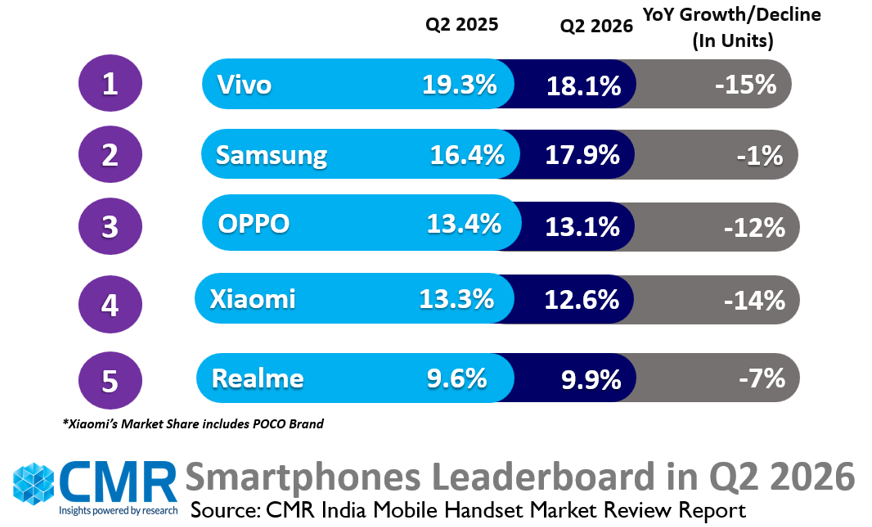
Vivo led the Indian smartphone market in Q2 2026 with an 18.1% share, followed by Samsung at 17.9%. OPPO held the third position with 13.1%, while Xiaomi (including POCO) ranked fourth with 12.6%. Realme completed the top five with a 9.9% share.
Commenting on the market dynamics, Menka Kumari, Senior Analyst, CyberMedia Research (CMR) said, “The Indian smartphone market in Q2 2026 reflected a widening gap in consumer demand. The Super Premium segment’s 72% YoY growth points to financing structures — zero-cost EMI, trade-in offers, and consumer credit — becoming the deciding factor in premium upgrades, not just AI features or camera hardware. Meanwhile, affordable and value-for-money segments remained under pressure as price-sensitive consumers delayed upgrades, resulting in a more polarized market.”
Feature Phone Segment
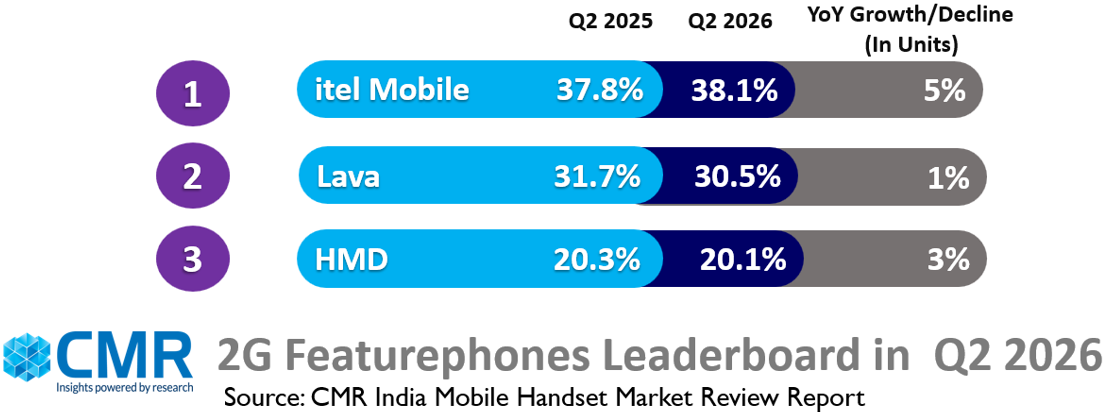
While the 2G feature phone segment grew 5% YoY, the 4G feature phone segment declined 43% YoY. Itel led the 2G segment with a 38% share, followed by Lava (30%) and HMD (20%).
Q2 2026: Key Smartphone Market Highlights
Vivo held the top spot with an 18.1% market share, despite a 15% YoY decline in shipments. The V70 was the leading contributor, reflecting Vivo’s continued strength across the value-for-money and premium segments.
Samsung followed closely with a 17.9% share. The Galaxy A07 led shipments in the value-for-money segment, while the Galaxy S26 Ultra accounted for 9% of shipments — reflecting Samsung’s simultaneous strength across both value and premium tiers.
OPPO secured third position with a 13.1% share, despite a 12% YoY decline in shipments. The A series and K series collectively contributed 57% of shipments, with momentum concentrated in the ₹15,000–₹20,000 and above segments.
Xiaomi (including POCO) held a 12.6% share, recording the smallest YoY decline among the top five brands at 2%. The Redmi A7 Pro 5G led shipments.
Apple captured 8% market share. The iPhone 16 series contributed 50% of shipments, while the iPhone 17 series already accounted for 35%, indicating a fast-maturing upgrade cycle sustained by strong premium demand.
OnePlus registered 28% YoY growth. The Nord CE 6 was the leading contributor to shipments.
Transsion shipments fell 32% YoY, impacted by softer demand in the affordable smartphone segment and increased competition.
MediaTek led India’s smartphone chipset market with 46% share.
The premium smartphone market (>₹25,000) was led by Qualcomm with 41% market share.
Future Outlook
CMR projects a 10–12% full-year decline for India’s smartphone market in CY2026, with affordable and value-for-money segments likely to remain under pressure due to cautious consumer sentiment, rising component costs, and increasing device prices.
“Rising component costs and higher device prices are expected to keep the sub-₹15,000 segment under pressure through H2 2026, as consumers extend replacement cycles further. The premium and super-premium segments (₹25,000+), by contrast, are on track to grow over 50% in H2 2026, driven by AI-enabled experiences, stronger camera performance, and premium design. This divergence reflects a structural shift in demand: affordability will continue to anchor the mass market, while differentiation — including emerging form factors such as foldables — will define growth at the premium end,” added Amit Sharma, Senior Analyst, CyberMedia Research (CMR).
Gurugram/New Delhi, June 29, 2026. India’s consumer SSD market witnessed a significant correction in Q1 2026 amid rising...
More Details
Gurugram/New Delhi, June 29, 2026. India’s consumer SSD market witnessed a significant correction in Q1 2026 amid rising...
More Details
Gurugram/New Delhi, June 29, 2026. India’s consumer SSD market witnessed a significant correction in Q1 2026 amid rising...
More Details